
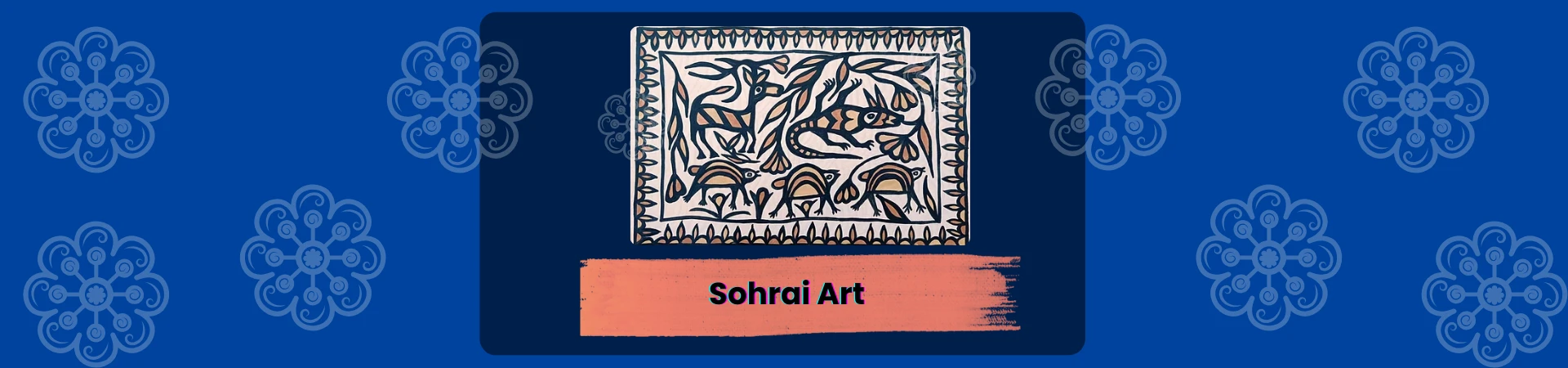
Sohrai Art: Tribal Wall Paintings of Jharkhand and Their Meanings
The visual tradition of India has always depicted the connection of tribal communities with nature. Sohrai art is one of the most colorful and significant ones. Sohrai art is practiced by the people of the indigenous tribes that live in Jharkand particularly the Santhal tribe, the Munda tribe, the Oraon tribe, and the Kurmi tribe but it is not merely a decoration. It is a tradition, which is deeply rooted in gratitude, storytelling, cultural identity and the rhythm of the rural life.
Sohrai wall painting is beautiful, painted on mud walls using natural pigments and it has always remained one of the most expressive forms of tribal paintings of Jharkhand and it has carried centuries of knowledge, rituals and symbolism.
What Is Sohrai Art?
Sohrai art is a traditional painting style on the walls that is painted during harvest festival of Sohrai which is held in October- November after Diwali. Sohrai is said to have originated by the name Sorii which translates to cattle driving hence the festival has links with livestock and wealth.
In Sohrai, village houses are turned into canvases. Women paint their walls with fresh cow dung and clay- the natural primer- and paint amazing motifs that bring out the symbol of fertility, nature and daily life. The paintings are not created with the help of brush, and women paint them with the help of chewed twigs or fingers or pieces of cloth, which makes each of the paintings organic and intuitive.
Interesting fact:
The Sohrai art in most of the villages of Hazaribagh is a significant indicator of family identity. The taste, themes, and colors may vary with different houses.
History and Origins of Sohrai Art of Jharkhand
The Sohrai art of Jharkhand is thought to be thousands of years old. Other scholars associate it with cave paintings in the area, like at Isko, that show a similar style, such as the use of geometry and animal figures.
The art form emerged as a religious ceremony related to the life of farmers. As the main activities of tribal communities are agriculture and cattle, both are praised by the festival and the art form. The skills have been taught to daughters by mothers over centuries and with practice rather than education they have maintained the legacy.
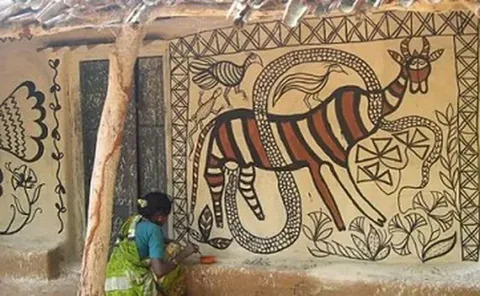
Rural woman crafting beautiful Sohrai Art inspired by nature and animals
Nature. Natural Materials: A Sustainable Art Form
Simplicity is one of the factors that have contributed to the continuation of Sohrai art. Artists are dependent on the readily available natural materials:
● Red ochre - to earthly tones of red
● Black - to earthly tones of black
● black manganese or soot -outlines
● White kaolin clay- highlights
● by themselves.
● Cow dung and stone dust and yellow.
● Brushes of twigs or rice straw.
It is a brilliant example of sustainable creativity as Sohrai art uses eco-friendly materials.
Visual Language: Visual Metaphors and meaning
The art of Sohrai is full of symbols, which mirrors the tribal world view. Each brushstroke and melody makes sense.
1. Animal Figures
In Sohrai murals cattle, deer, elephants, peacocks, and horses are also common.
● Cow and bull - prosperity, fertility, and security
● Deer- beauty, grace, and relationship to forests
● Elephant - power and good omen
● Peacock- rain, festivity, and colour
Interestingly, most of the murals have stylized animals with exaggerated appearances; this is an artistic decision, as it makes the photo energetic and moving.
2. Nature and Vegetation
The close relations between nature and people are represented by flowering vines, leaves, trees, and grain stalks. They give thanks upon having a bountiful harvest and pray that the seasons will come.
3. Geometric Patterns
Rhythm is achieved by triangles, lines, circles and chevrons between bigger motifs.
● Mountains are commonly portrayed as triangles
● Rivers or lightning are reflected in lines and zigzags
● Circles represent the sun, moon and time cycles
It is also felt that these patterns guard the homes against bad spirits.
4. Everyday Life Scenes
There are Sohrai wall paintings which have:
● Women carrying grain
● Men ploughing fields
● Cattle grazing
● Conventionally musical instruments
They are more of visual diaries, which are used to record tribal life and memories.
The Process: Letting Sohrai Wall Painting Live
Sohrai mural is a harmonious and communal process of creating. Here’s how it unfolds:
Step 1: Wall Preparation
There is a mixture of clay and cow dung mixed and plastered on the walls by women to form a smooth base.
Step 2: Drawing Outlines
They sketch on, with a twig, no preliminary drawing, no lines.
Step 3: Filling Colors
The application of natural pigments is done through fingers or pieces of cloth. The painting is created naturally and it is sometimes finished within one day.
Step 4: Final Touches
The mural is provided with contrast and life by using white kaolin. The dark lines beautifully counter the earth-colours.
Interesting fact:
Most Sohrai artists assert that the design is based on memory. They do not rehearse, the patterns have been assimilated by observing the mothers and grandmothers, painting through the years.
The Sohrai Art is significant in Tribal Culture
Sohrai art is not only aesthetically pretty but has a lot of cultural and spiritual meanings.
1. Expression of Gratitude
It is a period of gratitude to the Earth, cattle and nature. The symbolic sacrifice is painting the walls.
2. Social Bonding
The women gather in groups and share tales, sing and strengthen the sense of community.
3. Cultural Preservation
As the tribal lifestyles are being influenced by modernization, Sohrai art is an act of saving identity, language and ancestral knowledge.
4. Festivals and Rituals Role
Houses painted with Sohrai paintings welcome good fortunes of the new year.
Resurrection and International Fame
In spite of this conventional practice which was losing its importance, the active endeavor of local artists and cultural activists, particularly in Hazaribagh, has brought back Sohrai art.
Now it is not confined to mud walls. Sohrai motifs are used on:
● Canvas paintings
● Pottery
● Fabric
● Home décor
● Public murals
Artists such as Bulu Imam and the Tribal Women Artists Cooperative (TWAC) have been of great relevance in making Sohrai art to be exposed in international exhibitions.
nteresting fact:
This style, closely related to Sohrai and Khovar painting was was also named in 2019 as the Geographical Indication (GI) tag of Jharkhand, which increased the popularity of Sohrai and Khovar styles of art in the world.
Why Sohrai Art Is Everlasting and Relevant to This Day
Sohrai art has found an easy way to an aesthetics close to modernity in a world that is moving towards minimalism, earthly colours, and sustainable practices. Sohrai is also applied by many architects and designers to murals, the interiors of a boutique, and eco-homes.
The beauty of the piece, along with the story behind each motif, the unity with nature, the appreciation of life, and the praise of community is what makes the piece unique.
Frequently Asked Questions
1. What is Sohrai art?
Sohrai art is a traditional wall art practised by the tribal people of Jharkhand, which is performed during the festival of Sohrai harvesting. It was created using natural pigments in that it has motifs of nature, animals, everyday life, and geometric shapes.
2. Which are the materials Sohrai wall painting uses?
Natural colors utilized by artists include cow dung yellow, manganese black, natural red ochre and kaolin clay. The brushes are either created using chewed twigs, cloth or fingers.
3. What tribes do Sohrai Jharkhand art?
Sohrai art is mostly practiced by the Santhal, Munda, Oraon and Kurmi and other indigenous people in the Hazaribagh area of Jharkhand.
4. What is the difference between Sohrai art and Khovar art?
Sohrai is a painted art that is done during the harvest festival and employs freehand colorful designs. The art of Khovar is made during weddings, and characteristics of the art are monochrome patterns cut with a comb-cut technique.
Related Blog